What You Can Judge in Work You Cannot Read
An agency’s portfolio includes a reel in a language you do not read, and you still have to form a view. The usual responses are both wrong: hand the whole thing to someone else, or score it as though you understood every line.
The mistake runs in both directions
The first reviewer shrugs and writes “can’t tell”. The second rates the whole piece on how it looks and sounds to them, and files a confident score for a caption they could not read.
The working principle: craft is carried by several layers, and only some of them cross a language barrier. Cut, frame, performance and design travel. Copy, wordplay, register and reference do not.
Picture watching a short video with the sound on, understanding nothing, and still feeling sure it is good. That certainty is made of timing, a face that seems to mean what it does, a frame that feels deliberate, music that sits right against the picture. It is not made of the writing, because you have not read any.
What survives translation: grade these yourself
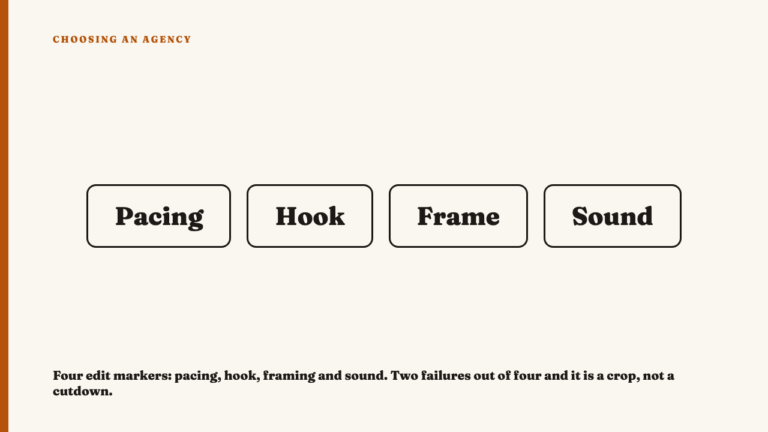
- Rhythm and cut. A well-timed cut arrives as a gesture finishes or a breath is taken, so the join goes unnoticed. A lazy one lands mid-motion, or leaves a shot sitting after its point is made.
- Framing. Where does the subject sit, and what is cropped? Work composed for vertical keeps the face and key object in the middle with room for the interface.
- Performance. Does the delivery look directed or merely recorded? Check eye line, whether the energy suits the setting or fights it, whether the performer seems to believe the words. Tone of voice is partly readable. The meaning of the words is not.
- Sound and feed consistency. Music against picture, the mix, silence used on purpose, and a visual system that holds over time.
- Design and typography. Hierarchy, spacing, contrast, consistency. You can tell whether on-screen text is laid out well, not whether it says anything sharp.
What does not survive: stay humble about these
Copy and wordplay live inside the language. A caption can look short and punchy to an outsider and be flat at home, or look clumsy and be exactly right.
Register is the quieter trap: formal against casual, slang that is current against dated, a tone that is warm in one language and condescending in another. An outsider cannot hear it, so you will not feel the wrongness and will not know to doubt yourself.
Cultural reference and humour work the same way. A joke, gesture, colour, holiday or format can carry meaning locally and nothing to you. It runs the other way too: something charming to you, like a gesture that is friendly in one place and rude in another, may be awkward at home. The same humility applies to work that was never made for you.
Subtitles and machine translation are a trap. Read a translated caption and you are grading the translator, not the agency.
The rule: where you cannot read, write “unknown” in your notes. Not a low score, and not a high one.
A sorting sheet for one piece of work
Complete the left column in writing before any native read arrives, so the second read cannot overwrite your first impression.
| Layer of craft | Who reads it, and what to look for |
|---|---|
| Cut | Grade it yourself. Do cuts land on movement and breath? |
| Framing | Grade it yourself. Composed for vertical, subject placed on purpose? |
| Performance | Partial. Eye line, energy and conviction are yours. What the words mean is not. |
| Typography and layout | Grade it yourself. Hierarchy, spacing, contrast. |
| Sound | Grade it yourself. Music against picture, deliberate silence. |
| Feed consistency | Grade it yourself. Does the system hold over time? |
| Copy | Needs a native reader. Does the line land? |
| Wordplay | Needs a native reader. |
| Register | Needs a native reader. |
| Cultural reference | Needs a native reader. Does it mean what the agency thinks? |
| Humour | Partial. Timing and delivery are visible. Whether it is funny needs a native reader. |
How to ask for the second read without handing over your judgment
Ask narrow questions, not “is this good”. Does the line land? Does the joke work? Does the tone fit the audience? Is anything awkward or off? Is the register right for the people it was made for?
Share the piece without your verdict, and without saying the agency is a candidate, so the reader is not tempted to be kind or to agree with you. Ask for the reason as well as the verdict: “it feels off” is a flag, so ask what specifically. You are collecting evidence, not a vote.
If the decision matters, use more than one reader, preferably with no connection to the agency.
Be careful about asking the agency to explain its own copy. They can say what it means, but then you are grading the explanation. The standard you want your reader to apply is in what separates a written caption from a filled in one.
The final call stays yours. The native read says whether the language layer works, and you weigh it against everything you graded directly. The next question is whether multi-market work is localised or just translated.
When the two reads disagree
Say the cuts land, the framing is composed for the format, the performer holds the screen, and a native reader calls the copy stiff, like a form letter. The strength sits with the visual team, and the writing looks like an afterthought.
Reverse it: plain visuals, a static frame and a flat edit, but the native reader laughs and says the line sounds like a real person from their town. The strength sits in the writing.
Either way the disagreement is information about the split between visual and writing teams, and a reason to ask who wrote the copy.
Sometimes the gap is too big to score. If the idea is the line itself, a pun carrying the whole post, your graded layers are decoration around something you cannot see. Set that piece aside rather than averaging a confident visual score with an absent verbal one.
What to write in your notes
Record three things per piece: what you graded directly and how confident you are, what you deferred, and what the native reader said and why.
To see how edited, named picks are presented, See this year’s selections. If you know an agency doing good work in a market the site has not covered, nominate an agency.
FAQ
Can I judge a video in a language I don’t speak?
Yes for cut, pacing, framing, design, sound and much of the performance. No for copy, wordplay, register and cultural reference. The sorting sheet shows which is which.
Are subtitles good enough to judge the writing?
No. Subtitles let you follow the meaning, but you are grading the translation and not the original line, and wordplay and tone usually do not carry over.