Judging Cause-Driven Social Content on a Shoestring Budget
You are looking at a cause-driven account’s feed and it is rough. Phone footage from an event, handheld wobble, a template reused eleven times. The instinct is to mark it down against glossier work, or forgive it on budget grounds. Both skip the question: did someone decide inside the constraint, or use it to stop deciding.
Why a small budget is a different craft test than a tight brand guideline
Name what is missing. No dedicated shoot day, so nothing was filmed at a chosen hour. No lighting kit, so the room is whatever the room was. No paid talent, so the people on screen are staff, volunteers and beneficiaries. A phone rather than a rig, often not the agency’s, because the footage is whatever someone else captured. And editing hours, which decide how many cuts anyone could afford.
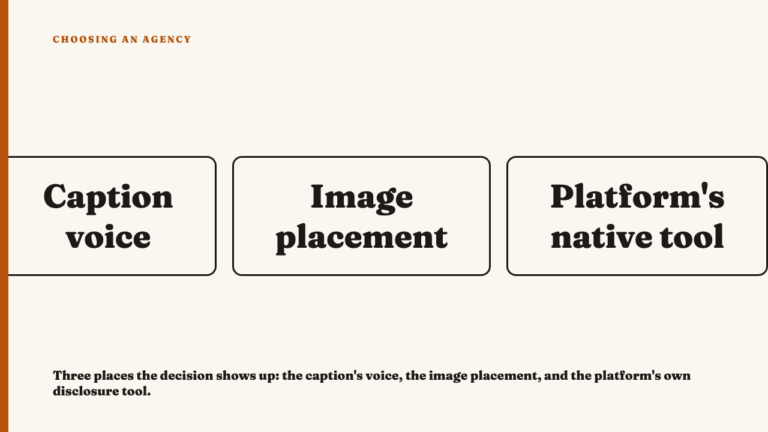
So the test is not “does this look expensive.” It is whether someone chose deliberately inside what was available, or the absence of budget became the reason nothing was chosen. That differs from judging work restricted by brand guidelines, where the limit is permission, not resources. Here it is what existed to film and how long there was to cut it.
What honestly accepting the constraint looks like on screen
Composed and bad phone footage separate quickly. Composed means the window sits behind the camera rather than the subject, the horizon is roughly level, nobody is cropped at the chin, and whoever held the phone braced against something. Bad phone footage is dark because nobody moved, tilted because nobody checked the frame, uncropped because nobody opened it again.
The caption tells you nearly as much. Copy that names the constraint reads like this: filmed on a volunteer’s phone during the second hour of the cleanup, which is why the sound is what it is. Copy implying a production the footage does not have is a mismatch, and people notice.
Honest framing leaves seams visible. A pan that shakes. Ambient event noise left in instead of buried under a stock music bed. Transparency, not failure.
The tells of low effort wearing the constraint as an excuse
Scarcity has a look. So does not bothering:
- Stock imagery with no connection to the cause or the event. A generic smiling group in a bright office, on a post about a food distribution. Free, not true.
- One template stretched across everything. The same coloured block and headline slot on an event recap, a thank you note and a policy statement alike, text clipping at the edge or crowding the face underneath. A template nobody adjusted was applied, not used.
- Captions padded with sector language. Impact, empowerment, vital work, your support makes it possible, and nothing about what happened or who was there. Specific detail costs only attention, which is why its absence is diagnostic.
- No visible editing decisions. Raw clips at full length in the order they arrived, no trim on the dead first four seconds, no sequencing. The clearest tell, because editing is what scarcity does not remove.
Reading footage the agency didn’t shoot
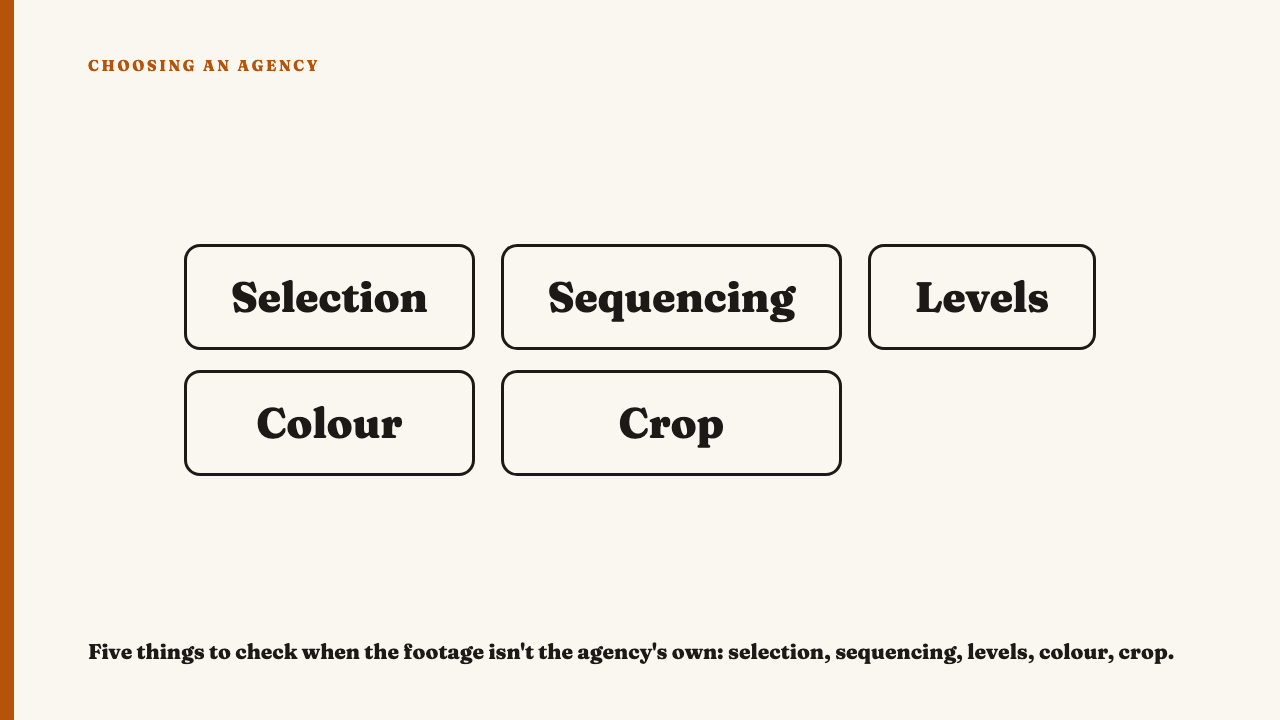
When the raw material comes from volunteers, the craft read moves rather than stops. Selection: which of the fourteen clips made it in. Sequencing: what opens and what pays off. Levels: whether audio jumps between sources or someone matched them. Colour: whether a warm indoor clip sits unreconciled beside a blue-cast outdoor one. Crop: keeping the mess at the edge of the frame is a decision, and so is tightening to hide it.
An agency that reposted whatever arrived, unselected and in the order received, still made a choice, and you can see it. That sharpens the question of how much of the work the agency actually made. It is also the line behind concept work versus work that actually shipped.
The same moment, two ways
Picture a volunteer cleanup day. Six phone clips arrive from three people, eleven minutes total, mostly walking and talking, with one moment where a heavy thing gets lifted and everyone laughs.
The first treatment runs forty seconds. It opens on the lift. Two other clips are trimmed to their usable middles and cut in behind it, levels evened so wind on one does not blast after the quiet of another. Natural sound stays. The caption says volunteers shot it on their phones, which is why it sounds this way.
The second posts one clip at full length, opening with ninety seconds of somebody walking toward a car park. The caption is a generic appeal line that would fit any post. The cover image is a stock photo of a beach at sunset. Same material, same budget. One was made and one was uploaded.
What this doesn’t tell you about the work
Nothing above tells you whether the cause raised money, whether any reported number moved, or whether the organisation is well run. Nor is this guidance on hiring, briefing or managing an agency. A public feed is also a curated sample, worth reading alongside what a portfolio leaves out.
Look at work that holds up
Test this read against work we have written up: see this year’s selections. Or nominate an agency whose scrappy work has decisions in it.
FAQ
Does low production value automatically mean an agency isn’t trying?
No. Production value and effort are different axes, and separating them is the point. A rough-looking post can carry real decisions about framing, selection and sequencing, and a slick one almost none.
How do you tell honest scrappiness from disguised low effort?
Three things. Whether the phone footage is composed, meaning light, level and framing were considered without a kit. Whether the caption names the constraint instead of writing over it. And whether selection and sequencing are visible.
Should an agency use stock photography when there’s no real footage available?
Judge it on relevance, not polish. A stock image genuinely connected to the event or the cause is defensible when nothing was shot. Generic stock picked because it was free, attached to nothing that happened, is the tell.
Does this apply to any small-budget social account, not just nonprofits?
Yes. It generalises to any account under real resource scarcity, where the material is whatever existed rather than whatever was commissioned. The examples here stay on cause-driven work because that is where the constraint is most often used as cover.
Sources
- Judging content under brand constraints, fetched 2026-09-07.
- Who actually made the work, fetched 2026-09-07.
- What a portfolio leaves out, fetched 2026-09-07.
- Concept work vs work that shipped, fetched 2026-09-07.