How to Judge a Call to Action as Copy, Not Boilerplate
You are scrolling an agency’s feed and every post, whatever it was about, ends with the same line telling you to follow, tap or visit. Is that a habit worth keeping, or a team that stopped reading its own work? The closing ask is the quickest place to find out, because it is the last thing anyone had to write.
Same line on every post: consistency or laziness?
A signature is a recurring closer that belongs to the brand’s voice and shifts a little with each post. It might be a dry aside after a deadpan post and a quiet invitation after a tender one. A stamp is identical wording no matter what came before it. A signature has a temperament. A stamp has only a position at the bottom.
Try a scroll test. Read only the last line of ten consecutive posts. If you could swap any closer onto any other post and nobody would notice, nobody wrote them. This piece is about the wording of a direct ask. How the closing seconds of a video are paced is a separate question, left alone here.
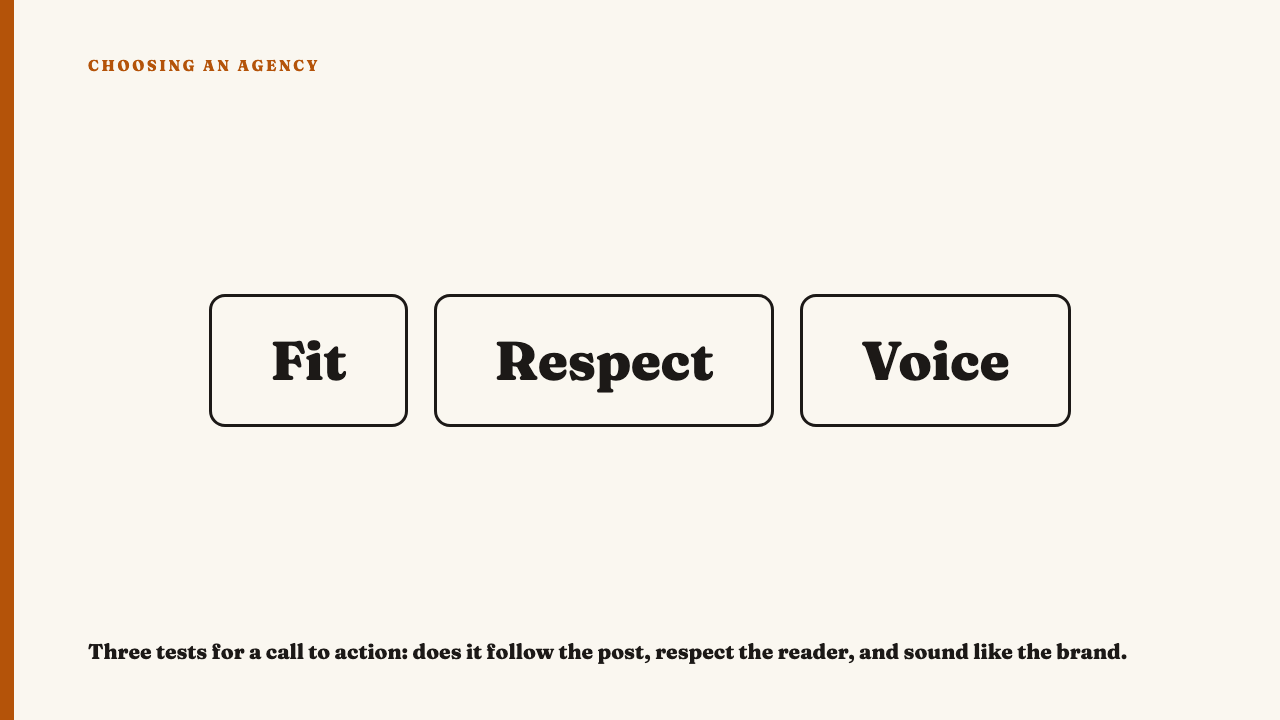
Test one: does the ask follow from the post?
Picture a short video that spends forty seconds building a small, funny argument about why nobody finishes the last page of a long menu. The viewer is nodding. Then the caption ends: “Don’t forget to like, share and follow for more content!” The spell breaks. The ask belongs to a different post.
Now the opposite. The same post ends on “Tell us the dish you always skip to,” and it feels like the next sentence of the joke. Remove it and the post feels unfinished. That is the mark of a written ask: taking it away leaves a gap. Watch for mismatched scale too, such as a throwaway post asking for a big commitment, or a post that earned a real prompt and gets a limp “let us know your thoughts.”
Position matters as much as wording. An ask buried after a wall of hashtags arrives after the viewer has left the thought. One placed where the idea has just finished feels like a continuation. An ask can also appear as on-screen text, as something spoken, or as a caption line, and a good post usually picks one home for it. When all three fire at once, the request starts to sound like pleading. This is about words on a screen, not timing.
Test two: does it respect the person reading?
The wording tells you how the brand thinks of its audience. Recognise these registers:
- Manufactured urgency. “Last chance!” with no deadline and no consequence.
- Guilt or shaming. Phrasing that makes not acting feel like a failing, as in “If you love good design, you’ll share this.”
- Stacked asks. Like, comment, share, follow and link in bio in one breath. Each request dilutes the others.
- Vague asks. “Engage with us” names no action, so the viewer has to guess.
A respectful ask is plain by comparison: one action, named clearly, with a reason the viewer would want to take it. “Send this to whoever picks the restaurant” is a single action with a built-in reason. Prompts designed to harvest comments are a different matter, covered in engagement bait versus real conversation design. Here we stay on wording.
Test three: does it sound like this brand?
Look for the tonal seam: a dry, understated post that ends in an exclamation-marked sales line, or a warm human caption that finishes in corporate imperative language. To check, read the caption aloud, then read the CTA aloud in the same voice. If you have to change register to say it, the same person did not write both.
Take an invented post from a fictional bakery about the first loaf out of the oven each morning, in short, unhurried sentences. Compare two closers:
Pasted: “Follow us for more amazing content! Link in bio!”
Written: “Come before eight if you want the heel. We will not tell anyone.”
The pasted line has no object, no reason and no relationship to the loaf. The written line keeps the caption’s dry warmth, names one action (come in early), gives a reason (the heel), and could only belong to this post.
Reading a portfolio’s CTAs side by side
Collect the closing line from several posts on each account the agency runs. Compare within one account first: does the ask change with the content? Then compare across the agency’s clients: do the closers differ in voice, or share a skeleton? Healthy variation is tied to content, with a recognisable temperament inside each account. Identical lines across clients suggest a house template. For the wider context, see what separates a written caption from a filled in one.
| What you see | What it likely means |
|---|---|
| Identical line on every post, across clients | A house template. Nobody wrote it for the account. |
| Identical line within one account, bending slightly each time | A signature. Check that the bends follow the content. |
| No ask at all | Either a chosen silence or a forgotten step. See below. |
| Ask that varies with the post | Someone wrote to a conclusion. This is the pattern you want. |
| Escalating asks that never change in tone | A pressure routine. On screen it looks like “follow” becoming “FOLLOW NOW” becoming “last chance to follow,” louder each time without being more considered. |
A missing ask is not automatically a failure. A post with a clear point of view, or a joke that has finished landing, can be right to end without an instruction. The tell is whether the post still lands as complete. If so, the silence was chosen. If it trails off, the ask was forgotten. And if the ask points to the bio, the link in bio is a landing page that deserves its own look.
Where to go from here
See this year’s selections and read their closers with these three tests, or nominate an agency whose closers you think were actually written.
FAQ
Is a repeated call to action always lazy?
No. A recurring sign-off can be a deliberate voice device. The test is whether it flexes to fit each post or is dropped in unchanged regardless of content.
Should every post have a call to action?
Not necessarily. Judge whether the omission looks chosen and whether the post feels complete without it.
Sources
- Judging caption and copy craft, fetched 2026-10-06
- Judging engagement bait versus real conversation design, fetched 2026-10-06
- Judging craft in link in bio landing page design, fetched 2026-10-06