Earnest or ironic: has the brand earned its register?
You are watching an agency’s reel and the brand on screen sounds sure of itself. Maybe it is dry and self-mocking, maybe warm and heartfelt. Either way you cannot tell whether that tone was decided or simply reached for. This is a different question from when a brand voice is distinct and when it is only loud, which is about audience fit. Here the axis is narrower: is the brand meaning it straight or winking, and has it earned that stance?
Register is a claim, and the brand has to be able to back it
Register is the stance a brand takes toward what it is saying: either meaning it straight, or signalling that it knows how it sounds. Both are claims. Sincerity claims there is something worth saying plainly. Irony claims the brand is secure enough to laugh at itself and the audience is in on it.
The test is fit. Ask what this brand can credibly say, then check whether the register matches. A brand with a real point of view can afford sincerity, because there is something to be sincere about. A brand with a thin product story needs more than a wink. Neither register is the better one, and your own taste is the wrong instrument here. You may love deadpan or find it exhausting, and neither reaction tells you whether the work is good.
Irony used as a shield
The pattern is visible once you look. Every post undercuts itself before the audience can. The product is never described in a way that could be wrong. The joke is about the format, or the brand’s own marketing, rather than anything in the world. Scroll twenty posts and ask what you learned about the thing being sold.
Run the deflection test: take the irony out and read the caption flat. If nothing is left, the irony was the whole content. The craft of the joke itself is a separate matter, covered in judging comedic craft in brand social content. This test only asks whether anything stands behind it.
Earned irony points the wink at a specific, true observation, and somewhere in the feed the brand is still willing to say one unhedged thing. That single straight sentence is what makes the jokes read as confidence. Check the comments too. When the replies are all people quoting the joke and none mention the thing being sold, the joke has swallowed the brand.
Sincerity used as filler
Picture three posts in a row: a thank-you to the community for an unspecified milestone, a caption about how much the team loves the people they serve, and an inspirational line about showing up every day. Each is pleasant. None could be wrong, and none could only have come from this brand.
Run the swap test. Replace the brand name with a competitor’s. If the post still works unchanged, the sincerity is a template. Now compare a caption that admits a product arrived later than promised and says what changed because of it, or one that names a dropped service and explains why. Earned sincerity has a specific detail, something given up or admitted, a sentence only this brand could write.
Earnest copy with no specifics also reads as evasive, which is its own kind of shield. For the craft underneath, see what separates a written caption from a filled in one.
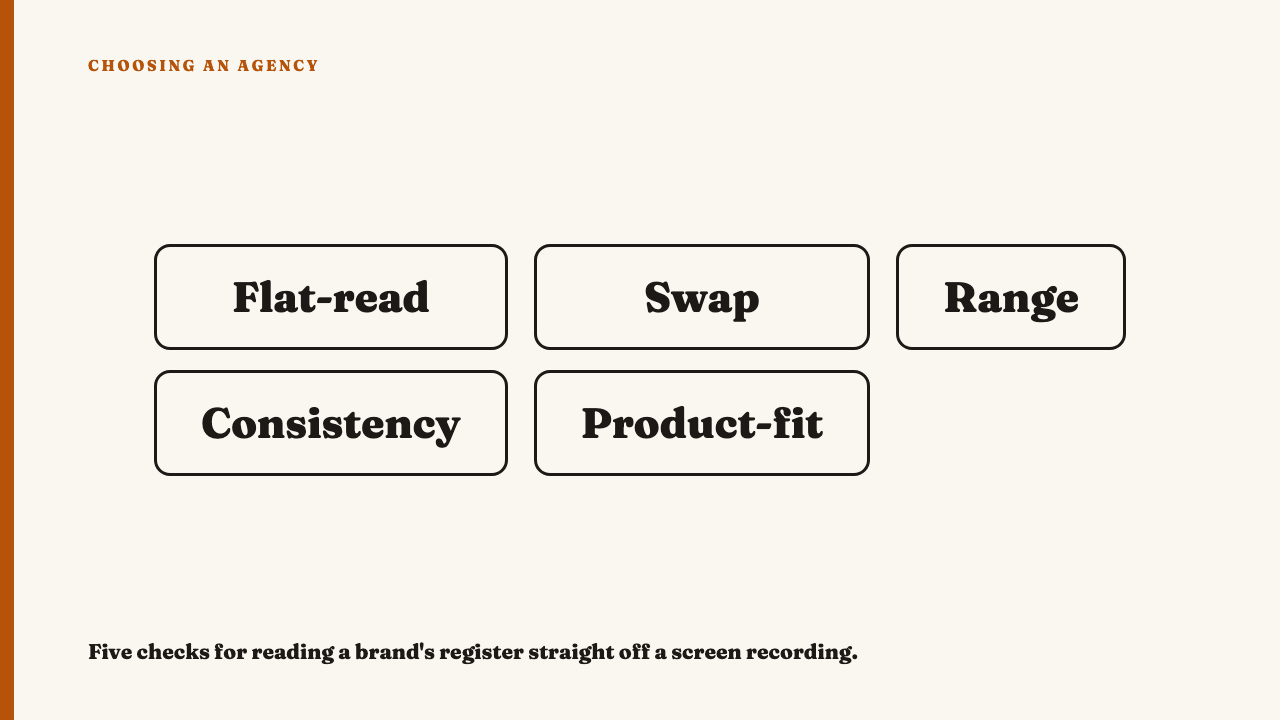
Five checks you can run on a screen recording
These are this site’s editorial heuristics, ways of reading the work, not research findings. Pause the reel and apply them one at a time.
- Flat-read test. Strip the tone and read the claim. Is there one?
- Swap test. Swap the brand. Does the post still work?
- Range test. Does the brand shift register when the subject demands it, such as a service problem or a sensitive moment, or is the voice fixed whatever is happening?
- Consistency test. Does the register survive across caption, video script, replies and bio, or only in the headline post?
- Product-fit test. Does the register match how seriously the audience takes the category? Do not assume serious categories forbid humour. A dry joke about a dull process can be exactly right.
Telling a choice from a template
A decided register leaves traces: consistent word choices, a visible set of things the brand will not joke about or will not gush over, and exceptions you can explain because the subject changed and the voice changed with it.
A template leaves different ones: the same sentence rhythm and punctuation habits whatever the subject, and a tone borrowed from whatever format is current, so the voice moves when the trend moves. A template can still be good craft in a limited sense. The point is to know which one you are looking at, not to condemn it.
Be careful with one source of evidence: the agency’s own description of the voice. Adjectives like confident, playful and authentic are not proof the voice exists on screen. See an agency’s own account is weak evidence of its work.
What to ask when the work is borderline
If a piece still leaves you undecided, put three questions about that specific piece. What could this brand not say in this voice? What did you decide against? Where does the voice break on purpose?
A good answer names a real constraint and a real trade, such as a running gag dropped because it crowded out the product. A weak answer describes the voice in adjectives and contains no trade.
Next step
To see this kind of reading applied, See this year’s selections. If you know an agency whose voice work holds up, nominate an agency.
FAQ
Is ironic brand voice riskier than sincere brand voice?
Neither is inherently riskier, because each fails in its own way. Irony fails by saying nothing, and sincerity fails by saying nothing specific. Look for the failure in the work itself with the flat-read and swap tests.
Can a brand use both irony and sincerity?
Yes, and a deliberate shift is one of the best signs of a considered voice. The shift tracks the subject: wry for everyday posts, plain and direct when something goes wrong. Inconsistency is different, because the changes follow trends or whoever wrote the post, and the subject cannot explain them.