Judging a Customer Story Video: Directed or Just Recorded
You are watching a customer story in an agency’s reel. It is warm, well lit and ninety seconds long, and you cannot tell how much of it is the customer thinking aloud and how much is the edit speaking in their voice. This post helps you answer that using only what you can see and hear.
Why a customer story is craft work, not evidence
This post reads the finished video as made work. It does not ask whether the customer was truly happy, and it does not touch the results. A person on camera is material, like a location or a piece of music. The craft is what the agency did with them.
That craft lives in three places: the questions asked off camera, the cuts made afterwards, and the limits placed on what the subject could say. You see only the output, but the output leaves marks. The failure to look for is a set of approved soundbites stitched to look like a conversation. It can be beautifully shot and still be lazy work. This is not an accusation of anyone, just a fair reading of the surface.
The question you cannot hear is the first craft decision
The interviewer is usually cut out, so infer the question from the answer. A good, open question produces an answer that starts mid-thought, wanders toward a specific detail, and holds a small surprise: a particular Tuesday, a colleague’s reaction, an awkward first week.
A leading question suggests the answer it wants, and the answer arrives complete. It restates a product benefit in the brand’s vocabulary and could open a brochure.
Here is a test. Try to reconstruct the exact question from the answer. If you can, and the question could only have had one answer, the interview was not directed. It was prompted. Answers that begin by echoing the question’s wording, such as “what I liked most was…”, are a sign of a script built from prompts.
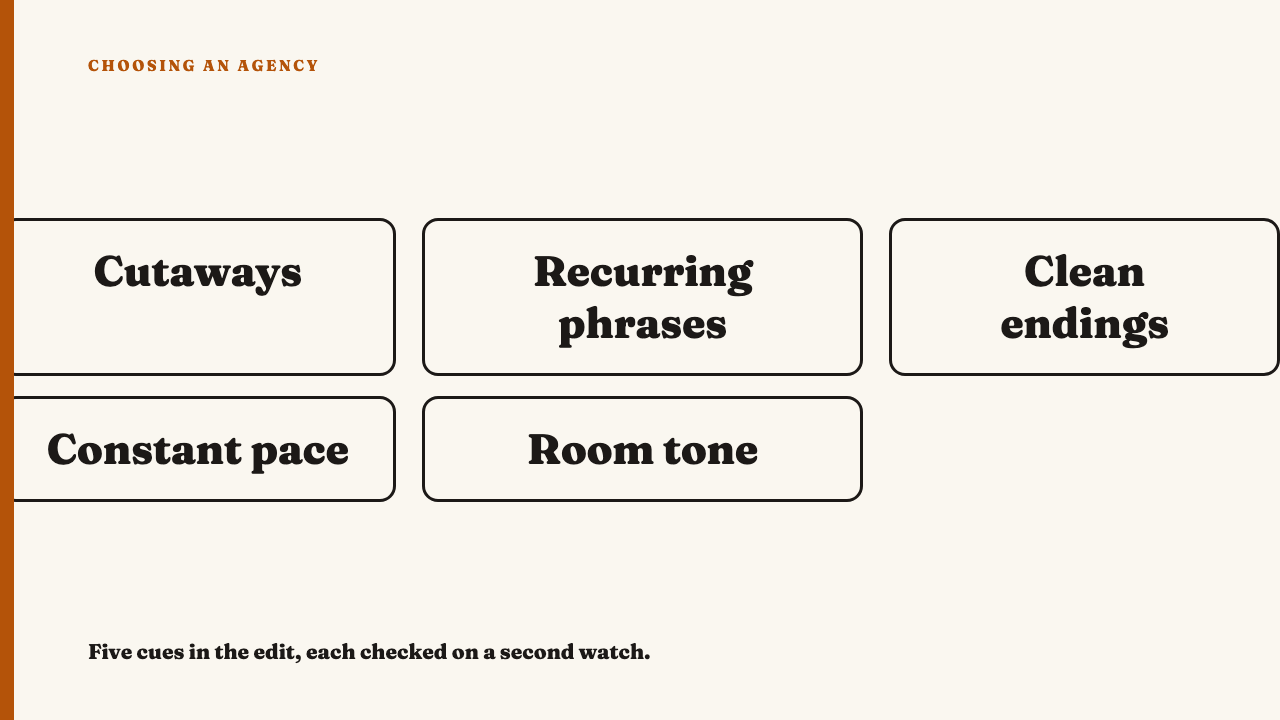
Five cues in the edit that give the shaping away
These are signals of shaping, not proof. Check them on a second watch.
- Cutaways that land where a seam would show. A cutaway inserts a view of something other than the speaker, often b-roll. Ask whether it illustrates the sentence or sits exactly where a jump cut would otherwise break the speech. Done well, it shows something the speaker did not say.
- Recurring phrases. The same two or three lines of brand messaging in different mouths, or in one mouth at even intervals. Done well, each subject has their own vocabulary, including words the brand would never choose.
- Endings that are too clean. Every line closes on a falling, finished note, with no trailing off, restart or overlap. Done well, some sentences end unevenly and the edit lets them.
- Constant eyeline and pace. Identical framing and speed in every answer, as if recorded in one sitting and read back. Done well, pace follows the subject: quicker when excited, slower when working something out.
- Room tone that changes under one sentence. The hum or reverb shifts mid-line, which can mean two takes were joined. Done well, the audio bed is continuous.
Does any hesitation survive?
This is the most telling signal, because it shows whether the edit allowed the subject to be a person. Surviving hesitation is a pause before a hard word, a self-correction, a half-laugh, a sentence that changes direction. A confident editor keeps one or two on purpose, because those are the moments a viewer believes.
A piece with zero hesitation was either rehearsed from a script or cleaned of everything human. Treat both as lower craft. Still, ruthless tightening is good editing, and nobody needs every “um”. The question is whether the cleaning removed filler or removed the person.
What the subject was allowed to say
A credible story usually contains one friction point: an early doubt, or something harder than expected. A well-directed piece uses that moment to earn trust, because once the subject admits a wobble, everything after it weighs more. The tell of a story with every rough edge removed is an arc of problem, product, joy, in one smooth line.
You cannot know what legal, brand or approval constraints applied. The skill is reading the finished surface honestly, not accusing the agency of faking anything.
Two clips, read side by side
Both clips are invented illustrations, not real work.
Clip A. A woman at a workbench. Her first answer begins mid-sentence: “I nearly didn’t, honestly, because the first call was a mess.” She restarts a sentence and mentions a delivery that arrived on the wrong day. The midpoint cutaway, a hand reorganising shelves, shows something she has not described. One answer is slower than the rest. Her closing line trails off in a laugh.
Clip B. A man in a tidy office. His first answer is “What I loved most was how seamless the process felt,” complete and level. The word “seamless” returns at the midpoint and in the final line. A laptop cutaway lands exactly where his speech jumps. Every answer has the same length, eyeline and falling ending, and the room tone shifts under his third sentence. No doubt or complaint appears.
Verdict. Clip A reads as directed: open questions, a friction point, a person left in the frame. Clip B reads as competent editing of approved lines. It is smooth, and the customer is hard to find inside it.
What to do with the verdict when you are reading a portfolio
One polished customer story shows an agency can edit. A range of them, with different voices, pacing and degrees of roughness, shows it can direct. Watch two or three interview pieces back to back and check whether phrasing, pacing and cut rhythm change with the subject. If every subject sounds like the same person, you have learned about the agency, not its customers.
The same shaped-versus-found question runs through other formats: the screenshotted testimonial or DM, and behind the scenes content when the access is staged. For the cut itself, see the editing decisions that separate good social video from filler, and for whose voice is on screen, ghostwritten founder content.
See work read this way
See this year’s selections, or nominate an agency whose work deserves a closer read.
FAQ
Can you tell if a customer testimonial video is scripted?
Not with certainty, but the finished surface leaves cues: answers that arrive complete, repeated brand phrasing, hidden cuts and no hesitation. Treat them as signs of how much shaping happened, not proof of dishonesty.
Is a heavily edited customer story bad craft?
No. Tight editing is good craft. The question is whether the edit tightened the person’s own thinking or replaced it with approved lines.
Sources
- Jump cut, Wikipedia (fetched 2026-10-08)
- Cutaway (filmmaking), Wikipedia (fetched 2026-10-08)
- B-roll, Wikipedia (fetched 2026-10-08)
- Leading question, Wikipedia (fetched 2026-10-08)