When a Caption Is Empty, That Was Still a Decision
You are looking at a post with no caption. Just the image, the account name, empty space where the words would be. Maybe a single emoji. The question is not whether you like the picture. It is whether somebody decided it could carry the post alone, or nobody could think of a line worth writing.
The caption field is not required, and that changes what silence means
An empty caption did not happen to a post. Somebody had the field open and closed it without typing, so it deserves the scrutiny of a written line. [EVIDENCE NEEDED: confirmation in each platform’s post composer that a post publishes normally with the caption field left empty] These posts go live regardless, which is why you are looking at one.
Before judging intent, rule out the boring explanation. Truncated copy, text belonging to a different image, a caption that renders on the web but not in the app: faults, not decisions. Once the blank is real, everything reduces to one question. Does the image or video complete a full thought with nothing added?
What a visual has to do to need nothing added
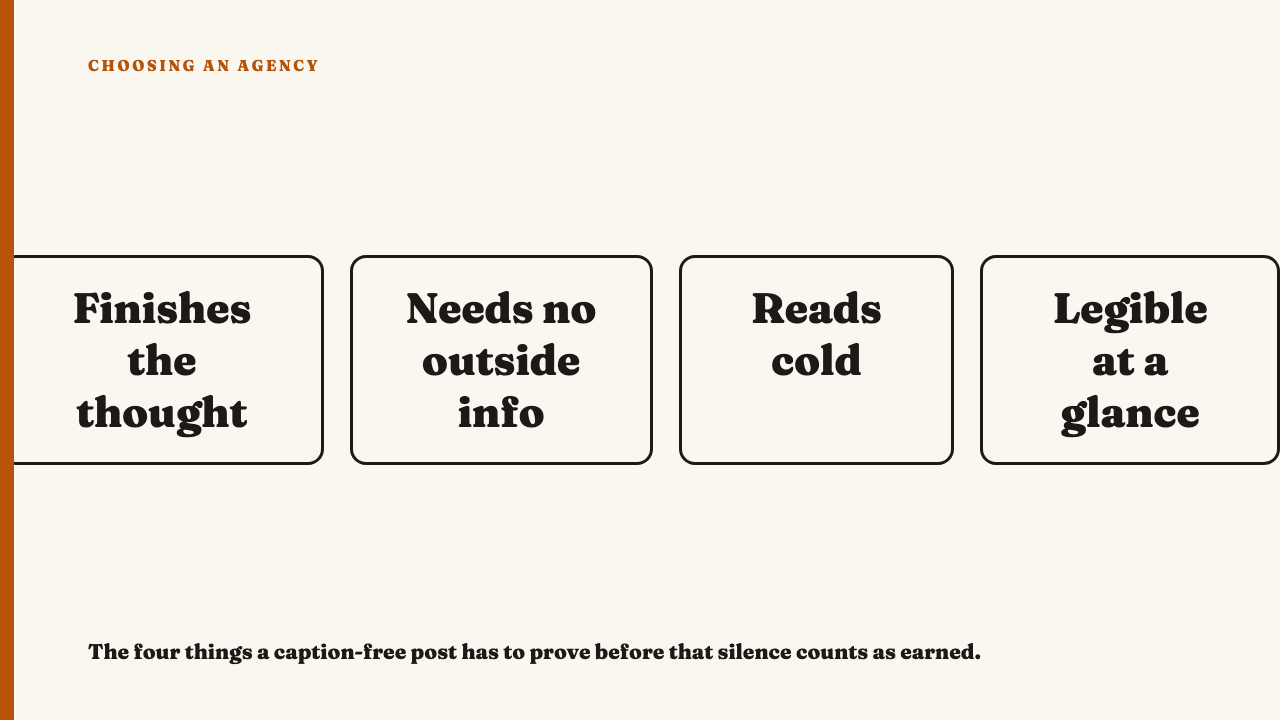
A caption-free post claims the frame is finished. Four things have to be true.
- The frame completes a thought by itself. A punchline inside the picture, an image striking enough that a sentence would get in the way, or a mark that reads without a beat of setup. If your reaction is “nice photo” rather than “oh,” nothing landed.
- Nothing outside the frame is needed. No name, date, price, place or link that only a caption could supply. If you are wondering what this is or when it opens, the blank is a hole.
- It works read completely cold. Not as post three of five, not as the follow up to yesterday’s tease. Working only for people who saw those is leaning on context this post did not earn.
- The subject is legible at a glance. No second pass to work out what you are seeing. Ambiguity that resolves into something clever is craft. Ambiguity that stays ambiguous needed a caption.
The three tells that the blank was a shortcut
Unearned silence shows up in three ways.
- The post needs information a caption would carry, and it is nowhere. A product shot with no name, an event graphic with no date. If the missing piece is not in the image or in on-screen text either, that is an omission, not minimalism.
- The visual is so generic it would need no caption on any account. A stock-feeling office interior, a coffee cup, a sunset. A post earns silence by being too specific for words to improve, not too vague for words to attach to.
- The blank appears whenever writing would have been hard. If the wordless posts cluster around the thin product update and the announcement nobody wanted to phrase, while easy posts get full copy, that is avoidance dressed as restraint.
A single emoji is a different bet than true silence
An emoji is authored copy. Small, but somebody chose it, and the same test applies. Does it point at something specific in the frame, or could it sit under almost any post?
A precise, unusual choice tied to a detail in the image reads as intentional, telling you where to look. A thumbs up or a heart with no connection to what is on screen is a placeholder wearing the costume of a decision, which is why one emoji and no words are not the same call. It is what separates a written caption from a filled in one, one character wide.
Video makes the bet bigger, not smaller
A still gets one shot to say everything. A video gets seconds, motion, on-screen text and an edit, far more room to do a caption’s job inside the frame. That raises the bar.
Picture two clips from a hypothetical furniture workshop, both with no caption. The first opens on a split chair leg, shows the repair, then holds on the finished joint long enough to register, with on-screen text naming the technique just as your eye goes looking for it. That one explained itself. The second drifts across tools and hands, nicely shot, no beginning, no payoff, no text, nothing legible without sound. Pleasant, and it explained nothing.
So judge the edit, not the appeal. Ask whether the cut, the sequencing and the on-screen text did the explaining a caption would have done, which is the territory of the editing decisions that carry a video without a caption.
Read it against the account’s pattern, not the single post
One wordless post proves little. A weak one might be an off day, a strong one luck. Look at several others and ask what the blank is for. An account that reserves it for the rare post that genuinely stands alone has a standard. An account where the field is empty by default has a habit.
Watch also for caption information turning up elsewhere: a pinned comment carrying the details, a bio link the post silently depends on, a follow up that explains the first one. Each is a workaround, and a workaround tells you the post needed words. A pattern of earned silence beats any single caption-free post, which is why reading an account’s pattern instead of one post matters.
Take this to a real account
Find a caption-free post, decide whether the frame finishes the thought, then check the grid to see whether the blank is standard or habit. If an agency’s work holds up under that, nominate an agency.
FAQ
Does leaving a caption blank hurt how a post performs?
That is a question about distribution, and not the one to ask here. Judge a blank caption on craft: whether the image or video earns the silence. A post that completes its thought inside the frame is good work. One that needed words and did not get them is weak regardless.
Is a single emoji caption the same as no caption?
No. An emoji is a small piece of authored copy, so it gets the test any caption gets. Is it specific to what is in the frame, or generic filler that could sit under any post?
What is the fastest way to spot a lazy blank caption?
Look for information the post clearly needs and cannot supply: a name, a date, a place, a link. If it is missing from the image, from any on-screen text, and from the post entirely, the blank was not for effect. It was a skip.