You are grading the brand’s reputation, not the post
You see a post and know it is good before you can say why. That certainty often arrives with the avatar, not after any reading. Here is a four step check for separating what the work does from what the name does for it.
The certainty that arrives before the reasons
Picture a flat product shot on a plain background, a one line caption, and an edit that is slightly loose, one cut landing a beat late. It comes from a brand you admire, and you nod within a second. Now picture the identical post under a handle you have never seen. You scroll past, or you pick at it: dull lighting, a careless edit. Nothing on screen changed. What changed is what you brought to it.
The halo effect is the tendency for a positive impression of a person, company or brand in one area to colour your opinion in another. According to the Wikipedia page on the topic, the term was coined by the psychologist Edward Thorndike, who gave the phenomenon its name in a 1920 article, “A Constant Error in Psychological Ratings”. The same page describes a negative twin, sometimes called the horn effect, where a disliked trait drags down the overall impression.
Social work is unusually exposed: the name, avatar and handle sit on top of every post, so you are never once looking at the work alone. The whole piece rests on one distinction: reputation is evidence about the brand, not about this post.
The same choices, read two ways
The halo quietly rewrites the adjectives.
| What is on screen | If you already admire the brand | If you have never heard of it |
|---|---|---|
| A caption of five words and no punctuation | Restrained. Confident enough to say little. | Lazy. Nobody bothered to write it. |
| Handheld video, slightly unstable, no polish | Raw. A deliberate turn away from gloss. | Cheap. Unfinished. |
| A visual choice that is odd and never explained | Deliberate. It trusts the viewer. | A mistake. Nobody knew what they were doing. |
| A slow first three seconds | Patient. It earns attention. | Dead air. A weak opening. |
The giveaway is the speed: if the adjective arrived before you could name a single frame or line that earned it, the brand supplied it.
Strip the logo, then read the craft
Recognition arrives third, not first.
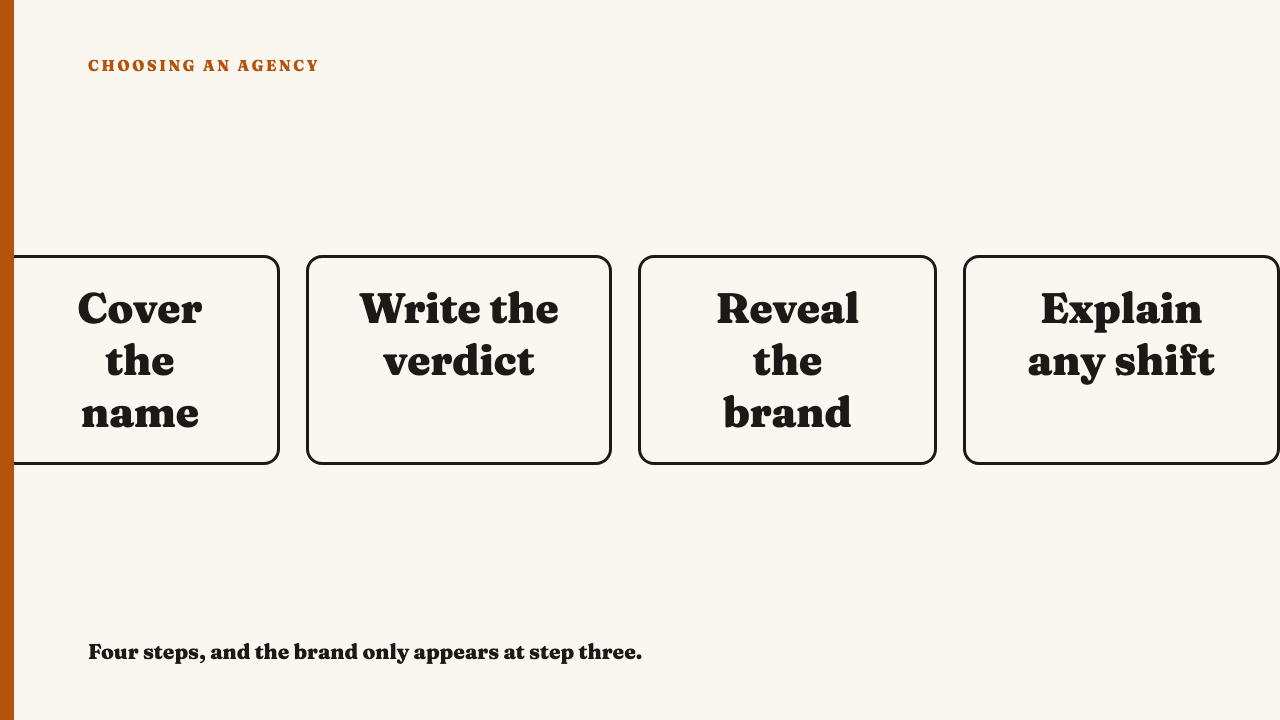
- Cover the name. Crop out or hide the handle, avatar, watermark, product packshot and end card. If it is a video, watch it with the end card cut off.
- Write the verdict before you look. One sentence on whether the work is good, the specific frame, line or cut it rests on, and how sure you are. This step is not optional: writing it down is what stops the reveal from quietly editing your memory of what you thought.
- Reveal the brand. Only now look at whose it is.
- Explain any shift. If your opinion moved, point to the frame that justifies the move. If you cannot, the movement is halo.
While the name is covered, read in this order: the idea, what the first moment does, the copy, the visual hierarchy, the edit and sound, how it ends.
The limit: you will sometimes recognise the work anyway, and a covered logo does not make you blind. The method does not remove bias. It reduces the effect and makes it visible.
Where recognition is allowed back in
Recognition is not the enemy. It is a bad first input, and once your read is committed it has two jobs. One is checking your read: if you loved a post blind and love it more now, fine, but ask whether anything on screen changed. The other is context. What a brand is allowed to say, and how strict its look is, change what counts as a good choice, as in judging craft on an account that has almost no room to move. Fame can tell you what the brief probably allowed. It cannot tell you whether the execution was good.
Now the uncomfortable case: a lukewarm blind verdict, then a glowing one once the brand appears. The second opinion is the less trustworthy, because it was formed with the name in the room. Keep the lukewarm note and ask what you saw in step 2 that you talked yourself out of.
The reverse happens too: a small account nobody follows earns a better blind read from you than a famous one. That does not make small better. It means the name was never the thing to go on, in either direction.
Where the halo hides in an agency’s portfolio
The wall of logos. A reel opens on a grid of client marks that holds for several seconds before any work plays. You have decided the agency is serious before anything has been shown. Treat the wall as packaging and start judging at the first real frame.
The household name. A piece for an enormous, instantly familiar client gets a warm reading because you recognise the product and the colours. You are crediting the agency for familiarity the client already owned. Judge what the agency could plausibly claim: the idea, writing and cut.
The agency’s own shine. A polished account, and the client work inherits the glow before you have looked closely. An agency’s own account is weaker evidence than you think.
The reverse scene. Near the bottom of the page sits a piece for a client nobody has heard of. The idea is strong, the copy precise. You skim it because there is no name to hang it on. Once the halo is gone, read the portfolio for what is missing.
Try it on something you already love
Pick one post you are certain is brilliant. Cover the name, write your verdict, and see which parts of the certainty survive. Surviving means you can still name the frame, line or cut that earns it.
See this year’s selections and form your own read. They are editorial, so disagree freely. And if you know an agency worth a look, you can nominate an agency.
FAQ
What is the halo effect in judging social media work?
A good impression of the whole brand leaks into your verdict on one post. Per Wikipedia, Edward Thorndike named it in a 1920 article, “A Constant Error in Psychological Ratings”, and its negative mirror is sometimes called the horn effect.
Should a famous client on an agency’s reel raise or lower my opinion?
Neither, by itself. The client’s fame is evidence about the client. Judge the idea, writing and cut the agency could plausibly claim.
Sources
- Halo effect, Wikipedia, fetched 2026-09-21