You Cannot Judge a Video From a Still, and Most Portfolios Hand You Stills
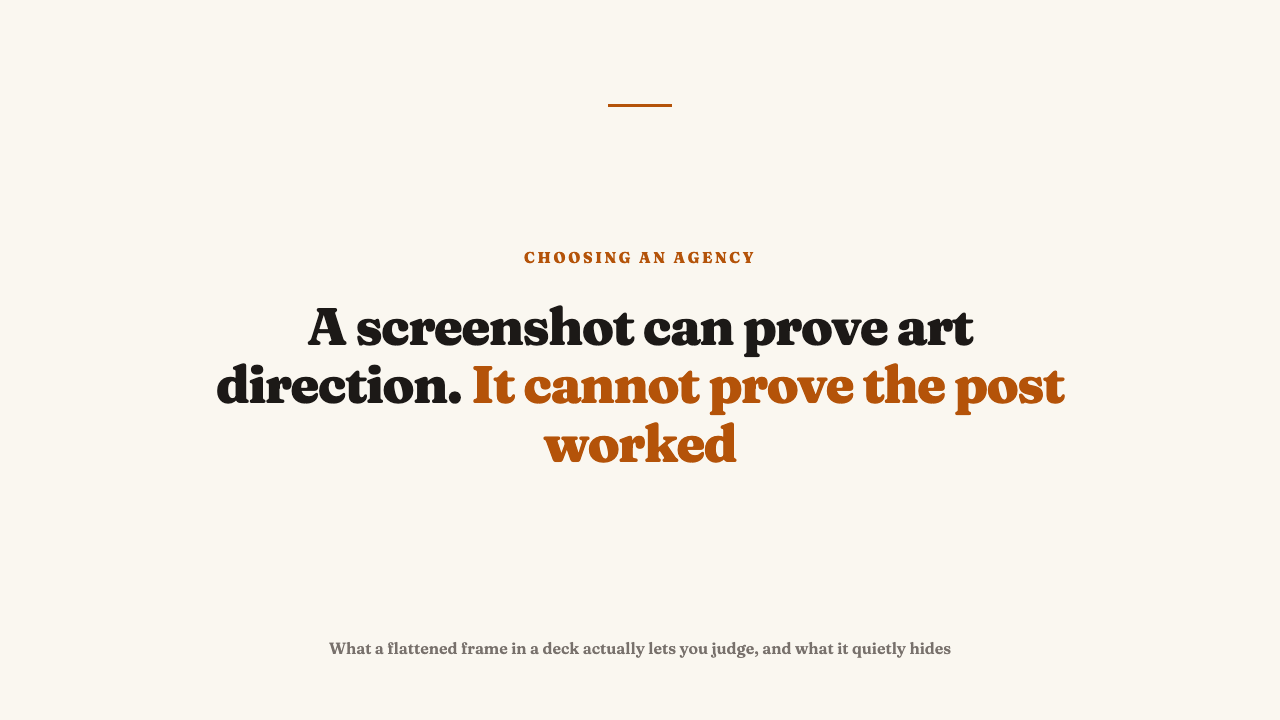
You are looking at a slide. On it is a single frame from a social video, cropped to fit the template, sitting next to three other frames like it. Nothing about the slide tells you it used to move, had sound, and lived inside a scrolling feed with a caption underneath it. You are about to form an opinion about the work anyway. The question worth asking first is what that one flattened frame can actually prove, and what it cannot.
The deck is not the post
A piece of social video is made a specific way. It has an aspect ratio built for one platform, it moves, it usually has sound, it carries a caption, and it sits inside a sequence on a feed, with posts before and after it. By the time that piece of work reaches a credentials deck, most of that has been stripped away. What survives is a single frame, often taken mid scroll rather than at a moment anyone chose, cropped to fit a rectangle on a slide.
This is usually not an attempt to mislead you. Decks get built quickly, for a room, on a deadline, and a still fits a slide template without breaking it. The problem is not that the flattening happens. The problem is what happens next: the evaluator forgets it happened, and treats the still as though it were the post.
What a still can actually prove
- Composition and framing. Balance, crop, and where the eye lands first are fully visible in one frame.
- Type and graphic design. Font pairing, hierarchy, color, and legibility against the background are static layers a frozen frame carries intact.
- Image quality. Photographic or illustrative craft, whether the shot looks considered rather than grabbed, can be judged on that frame’s own terms.
- Brand consistency across a set. Line up several stills side by side and this gets easier to see, not harder: removing timing isolates the pattern in type, color, and layout across posts.
What a still cannot prove, no matter how good it looks
Several craft dimensions are not static properties. They live in time, sound, or sequence, and a frame has none of those. Pacing and edit rhythm are the clearest case: how long a shot holds, where the cuts land, whether the piece front loads its best material. Writing suffers the same fate: the caption that gave the post its wit is usually cropped out, and a voiceover script exists only as audio nobody hears in a deck review. Sound design disappears entirely, so there is no way to tell whether a cut was built to land on a beat.
Sequence is invisible too. Whether the post worked inside its feed depends on what ran before and after it, none of which survives being pulled out as a single image. Performance on camera is a moving, timed thing, judged from a frozen one.
The specific wrong judgment this produces
Picture a hypothetical credentials deck showing the opening title card of a video: clean type, a confident layout. It is easy to read that one strong frame as evidence the whole video is well edited, but a title card is often the single frame where a designer had unlimited time and no constraint from motion or sound. The mirror error happens just as often: a flat opening frame, the kind that happens when you freeze a video at a moment nobody chose, can get a well paced piece marked down before anyone has seen it move.
Both errors are worse than saying “we could not tell from this.” An honest gap leaves you cautious. A wrong judgment leaves you confident, which is more dangerous, because the evaluator walks away with a settled opinion the still was never capable of supporting.
Get the live version before you rule on anything time based
Ask for the account handle and date or caption text of the post, then find that post on the platform it actually ran on. If the deck only shows a cropped frame, ask whether the source video or account is available to view. An agency confident in its pacing and sound work has no reason to withhold either.
Once you are looking at the live post, the still based judgments, composition, type, brand consistency, still hold. What changes is that the time based ones, pacing, sound, sequence, are now judgments you can make honestly rather than guess at. If the account is private or taken down, say plainly that pacing and sound cannot be judged from what remains, rather than assuming the still tells you what the missing video would have shown.
Editorial selection on this site works from the same principle: describe what good craft looks like, concretely enough to recognise. You can nominate an agency whose work you think holds up when you look past the deck.
A short checklist before you score anything from a slide
- Is this frame static in its original form, a graphic, a carousel slide, a photo, or a freeze frame taken from something that moved?
- If it moved: do I have the actual video, or only this one frame?
- Am I about to say anything about pacing, sound, writing, or sequence based on this frame alone?
- Have I asked to see the live post before finalizing that judgment?
FAQ
Is it fair to judge an agency’s design and type work from a still?
Yes, more than fair. Composition, type, hierarchy, and color are static properties in the first place, so a well chosen still is a legitimate way to judge them.
What is the single most common thing wrongly judged from a still?
Editing pacing and sound design. A frozen frame carries neither, yet a strong looking frame gets read as a stand in for a well cut whole far more often than the reverse.
If a deck will not or cannot show the live post, what does that tell me?
It limits what you can conclude, not what you should assume. Treat it as a gap in the evidence for the time based dimensions, rather than reading the absence as either guilt or innocence.
Does a flattened frame ever make judging easier?
Yes, for one thing: comparing brand consistency across many posts side by side, where removing timing helps you see the system.
Sources
- what a portfolio leaves out, fetched 2026-09-09
- the editing decisions that separate good social video from filler, fetched 2026-09-09
- the sound choices that give away a rushed edit, fetched 2026-09-09
- judging whether an agency built a system or just one good post, fetched 2026-09-09