Judge the Tuesday Post, Not the Hero Campaign
You have watched the showreel, and it looked good. The problem is that the showreel was built to look good. If you want to know what working with an agency would actually feel like week to week, its proudest campaign is the wrong place to look.
The campaign is the wrong sample
A hero campaign gets a disproportionate share of an agency’s time, budget and senior attention. It reflects how the client chose to spend for that one push more than it reflects the agency’s normal baseline. When a launch is coming, the best writer gets pulled in and revisions continue until someone senior is satisfied. That is not a flaw in the campaign. It is simply not representative of a Tuesday.
It is also the one moment everyone at the agency is watching closely, which is exactly why it cannot show what happens when nobody is watching. Judging an agency by its single best post is a sampling problem, the same way judging a restaurant only by its tasting menu tells you what the kitchen can do with unlimited time and a captive audience, not what turns up on a busy Tuesday night.
Where to actually look
The slice worth studying is the routine, low-stakes output: a holiday teaser, a small feature update, an announcement with no real news in it. Nobody fought over these in a review meeting, and nobody is putting them in next year’s pitch deck.
Finding them is mostly a matter of scrolling past. Skip anything that reads as a launch, a paid push, or an obvious hero asset, then stop on the stretch that looks like nobody argued over it. These posts make up the majority of any account’s output, so there is no shortage to sample. A hero post might appear once a quarter. The routine post fills every week in between.
What to check on a filler post
- Hierarchy. Look for a single, clear focal point. Your eye should land somewhere on purpose in the first second. If it drifts because nothing was designed to catch it first, that is the tell.
- Crop and composition. A deliberately cropped subject respects the frame: sensible headroom, placement with intent rather than centred by default. A post that looks like whatever the source image happened to contain is the opposite.
- Whether the caption does any work. A caption that earns its place adds an angle or a reason to keep reading that the image alone does not supply. One that restates what is already visible and appends a hashtag is filling a field, not writing.
- Whether the format was chosen or defaulted to. Ask whether this piece needed to be a carousel, a single image, or a short video, or whether it simply arrived in whatever format the account always uses. Reaching for the same format regardless of content is habit, not judgment.
A concrete comparison, without naming anyone
Picture two routine announcement posts, the kind that exist to note a small update and nothing more. The first keeps its type inside a real grid, with a caption that has an actual point of view rather than a flat restatement of the headline. The second crams its type against the edges of the frame because nobody checked the margins, and its caption is a placeholder, present because the field could not be left empty, saying nothing a reader could not have guessed from the image.
Neither post will appear in a portfolio. But one shows a team that holds its standards when nobody is grading the assignment, the other shows a team that reserves care for the moments it expects to be watched. You will not find this difference in a montage of hero work. You find it only in the routine post itself.
Why the floor predicts the relationship better than the ceiling
The hero post shows what an agency can do under ideal conditions: enough time, enough attention, enough people checking the work. The floor shows what it does under normal conditions, which is most of the relationship you would actually be entering. If type discipline and caption care hold up on a post nobody will remember, they will very likely hold up on the posts that matter to you too, because that consistency reflects a standard rather than a performance for an audience.
This is a claim about craft visible on the public account, not about how an agency is staffed, priced, or contracted. Those questions matter, but belong to a different kind of evaluation. What you can read here is whether the standard on display in the best work is the standard the account actually runs on, or whether it was switched on for one occasion.
A short way to run this check
- Open the account’s public feed. No login or insider access is needed.
- Scroll past the launches and campaigns until you reach the least remarkable stretch.
- Pick three routine posts from that stretch.
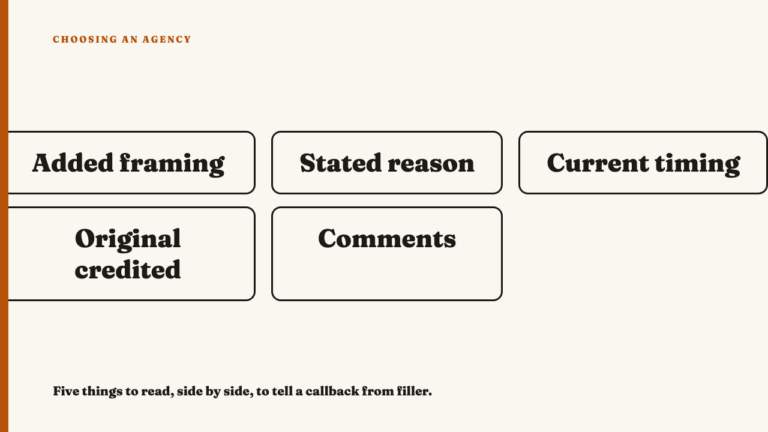
- Run each through the four checks: hierarchy, crop and composition, whether the caption does any work, and whether the format was chosen or defaulted to.
- Compare what you find against the impression the hero content gave you.
The whole check takes minutes, not hours, and needs nothing beyond a browser and the account itself.
Before you go further, two things worth reading next
If sampling broadly rather than trusting one impressive post is a new idea, the companion argument is that one excellent campaign tells you almost nothing on its own. Working from a portfolio rather than a live account? It helps to know what a portfolio leaves out. And if the account is the agency’s own rather than a client’s, treat it carefully, because an agency’s own account is weak evidence of its work in a different way.
When you are ready to look past any single post, you can nominate an agency whose routine work you think holds up.
FAQ
Isn’t the hero campaign still worth looking at?
Yes, but only as one data point among several. It shows the ceiling, not the floor, and the floor is the one almost nobody thinks to check, yet it is the one actually representative of most weeks with an agency. If an account genuinely has no routine posts to sample, only launches and campaigns, that is a limit worth noting. Do not manufacture a floor where none exists.
How many posts should I look at before forming a view?
This piece is not making a claim about a specific number, and no fixed count would hold up across accounts of different sizes and posting frequencies. Sample broadly across time rather than fixating on one post, and let the pattern across several, not a single one, shape your view.