An Agency’s Accolades Don’t Tell You If This Work Is Good
You open an agency’s reel already knowing it’s decorated. Before you’ve really looked at anything, your read of the work has shifted. That’s not a character flaw. It’s a predictable reasoning error, and it’s worth naming so you can catch it happening in real time.
The shortcut recognition offers, and why it’s tempting
What’s happening is a halo effect. A credential earned on some other piece of work, at some other point in time, quietly raises the score you give to the specific thing in front of you now, even though that credential had nothing to do with this piece. Your brain treats “this agency is decorated” as evidence about “this post is good.” Those are different claims.
Here is the moment it happens. You’re scrolling a reel, already aware the agency is decorated. You reach the fourth slide of a carousel and something is a little off, the copy doesn’t quite land, a visual choice feels arbitrary. On its own, that slide would earn a raised eyebrow. Because of what you already know about the agency, you give it a pass instead, assuming there’s a reason you’re not seeing rather than the plainer one: nobody checked it closely enough. The same effect works in reverse on an unknown agency doing something genuinely sharp, which gets less benefit of the doubt for having no reputation behind it.
What recognition actually measures
Ask a more basic question: what does industry recognition reward? Not craft alone.
- How well the work was framed and submitted, independent of the work itself.
- Which category it competed in, and how thin or deep that category happened to be that cycle.
- Who happened to enter that year, since recognition is relative to the field that showed up.
- Whether the underlying idea matched a trend already in the air, a different skill from craft.
- How good the agency is at self-promotion and visibility generally.
None of these inputs are about the specific post you’re currently looking at. They describe a different piece of work, submitted under different conditions, against a different set of entrants at a different moment.
The work in front of you didn’t ask to be graded on a curve
Judge the piece the way this site judges everything: the strength of the idea, whether the execution matches the concept, how specific it is to the platform and audience it was made for, and whether the choices look deliberate rather than templated. A strong idea has a point of view you could describe in one sentence without the word “authentic.” Execution matching concept means the hook earns attention for a reason connected to the idea, not just volume. Deliberate choices show up as small consistencies, a visual motif that recurs on purpose, a caption doing something the visuals can’t.
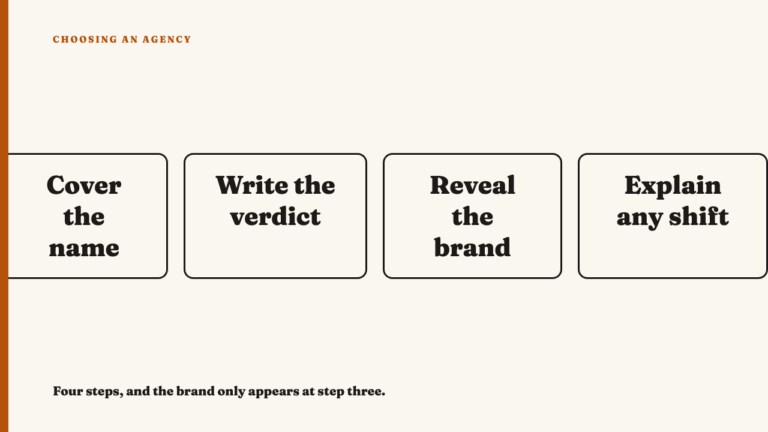
The practical instruction: look at the piece with the agency’s name covered, and form a view as if it appeared with no name attached. Only once you’ve written down what you actually think should the agency’s reputation, or lack of one, back into the room.
A sequence that keeps recognition in its place
- Evaluate the specific piece cold, with no name, accolades, or context attached.
- Write down what you actually saw: what worked, what didn’t, what felt deliberate versus accidental.
- Only then look at the agency’s reputation, using it solely to ask why your read and their reputation might diverge, not to revise the read you already wrote down.
When the two disagree, treat that as a question worth investigating in more of the agency’s work, not a correction to the piece you already looked at. A weak entry inside a decorated portfolio might be an outlier, or it might be a pattern you hadn’t noticed yet. Go look before you decide.
When reputation and craft line up, and when they quietly don’t
Picture a decorated agency whose carousel has a hook slide that earns the swipe on its own merits, followed by a closing slide that pays off the opening premise. That piece holds up on a cold read.
Now picture a different decorated agency, portfolio full of recognition, whose carousel has a slide five that contradicts a claim made on slide one, the kind of thing nobody checked the sequence for before publishing. That piece does not hold up, reputation aside.
Both are illustrative composites, not real agencies or real award programs.
When you want to see how editorial selection actually works, without a submission fee or a category to win, see this year’s selections. If you think an agency’s work deserves that kind of close read, you can also nominate an agency.
Recognition is easier to accumulate than it used to be, which makes it prove less
There are more places now for an agency to display external validation than there once were: badges, “as seen in” pages, shared recognition posts. Each is a display surface, and a display surface can reflect either genuine editorial vetting or an agency’s own submission activity and self-promotion. From the badge alone, you usually cannot tell which.
The distinction worth holding: recognition from an independent party reviewing an agency’s actual output differs from recognition earned through a submission the agency itself selected, framed, or paid to enter, and the two look identical once reduced to a badge on a website. Treat an agency’s own display of its accolades with the same skepticism this site applies to an agency’s own account is weak evidence of its work, a claim it makes about itself, curated by itself. The same logic applies to what a portfolio leaves out.
Remembering that one excellent campaign tells you almost nothing about consistency, the same logic applies when work can perform well and still be bad work. An external signal is adjacent to craft, not a replacement for it.
FAQ
If an agency has been recognized or won industry accolades, does that mean its work is good?
Not on its own. Recognition measures submission quality, category competition, timing, and self-promotion as much as it measures craft, so it’s a reason to look closer at the specific piece, not a reason to look less closely.
Should I ignore an agency’s accolades completely when evaluating its work?
No. Treat accolades as context you consult after forming your own read of the specific piece, mainly useful for asking why your read and the agency’s reputation might disagree.
Sources
- An agency’s own account is weak evidence of its work, checked 2026-09-23
- What a portfolio leaves out, checked 2026-09-23
- One campaign is not a body of work, checked 2026-09-23
- Work that performed and was still bad, checked 2026-09-23